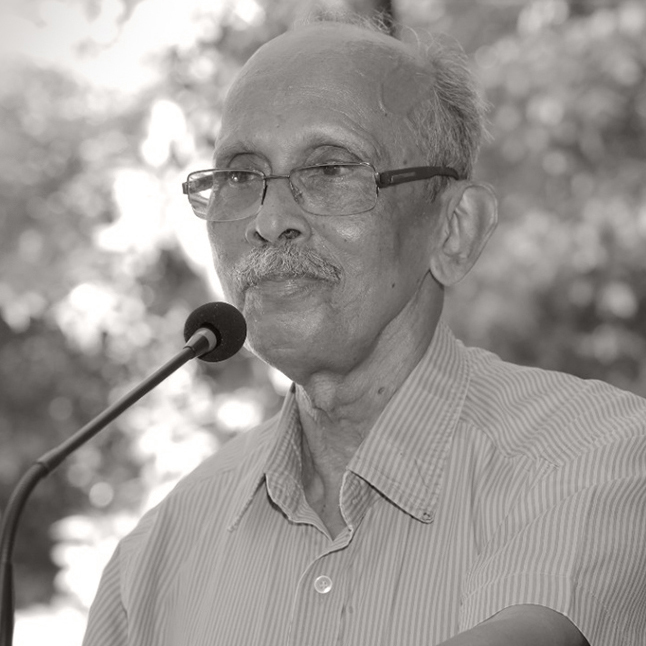
The 177th Seminar of the Global Millets Foundation (GMF) and the Sustainable Development Forum (SDF) was held on 28th December 2025. The programme began with a welcome address by Dr. K. M. George, who highlighted the objectives of GMF and SDF in promoting millets, wellness, and sustainable development. This was followed by the Presidential Address by Executive Chairman Dr. Mathew Abraham, who explained wellness as a holistic concept encompassing physical, mental, and social well-being.
RECLAIMING CREDIBILITY:MODERNISING INDIA’S NATIONAL ACCOUNTSFOR A DYNAMIC AND TRUSTWORTHY ECONOMY(Policy Paper )
India stands today at a decisive inflection point. As one of the world’s fastest-growing economies, its national statistical architecture must be robust, contemporary, and globally credible. Yet the recent IMF downgrading of India’s National Accounts Statistics (NAS) to a ‘C’ grade—the second-lowest category—has exposed long-standing structural vulnerabilities.
The IMF observed that India continues to rely on an outdated base year (2011–12), incomplete datasets, inconsistent methodologies, and delayed revisions that undermine reliability. A dynamic economy requires dynamic measurement. National accounts shape policy-making—forming the backbone of GDP estimation, GVA analysis, fiscal strategy, sectoral prioritisation, inflation targeting, and monetary policy.
Empowering Young Professionals for Sustainable and Inclusive Growth
Young professionals today stand at a decisive intersection of demographics, development, digital disruption, and planetary sustainability. Their empowerment is no longer a social aspiration but an economic urgency. While nearly 1.8 billion people globally are between 15 and 35, vast structural inequalities—between North and South, urban and rural, digital haves and have-nots—persist, preventing millions of young professionals from contributing meaningfully to national development and global sustainability.
THE TEN CROWNS OF 2025:The Most Essential English-Language Books of a Transformative Year
As 2025 draws to a reflective close, readers, critics and librarians across the English-speaking world agree on one thing: this has been a year of bold imagination, deep moral inquiry, and an unmistakable global shift in literary energy. The best books of this year have not merely entertained; they have challenged our assumptions, disturbed our complacencies, and reminded us of the power of language to bridge continents.
When the Eagle Steps Back: Washington’s AI Reckoning and the New Global Tech Order or How the End of AI Bailouts is Rewriting Innovation, Power, and the Future of Human-Centred Technology
Washington’s recent declaration that there will be no federal bailout for the AI sector represents a dramatic shift in global technological thinking. After years of exuberance—fuelled by massive funding rounds, exponential model sizes, and sky-high valuations—the US government has emphatically signalled:
“AI must stand on its own feet.”
This moment reshapes global expectations.
Ukraine at a Strategic Crossroads: Implications for Asia, the Indo-Pacific, and the Emerging Multipolar Security Order
As the 27 November deadline attached to President Donald Trump’s proposed Ukraine peace framework approaches, global politics stands at a critical inflection point. For Ukraine, the ultimatum arrives amid weakened battlefield leverage, internal governance stresses, and sharply declining Western military support. For the United States, it marks an effort to reset its strategic commitments; for Europe, a test of strategic unity and responsibility; and for Russia, a potential exit from a costly war whose long-term economic sustainability is uncertain.
Would America Be Weakened Under a Trump Presidency—And Would China Gain the Upper Hand in the New Global Order?
The twenty-first century is accelerating towards a world without certainties. Old powers feel increasingly constrained, and newer powers feel emboldened. America’s long-held assumption of being the unquestioned leader is being challenged not only by China but also by a constellation of rising middle powers and restless Global South coalitions.
A Trump return to the White House—amid a fractured political landscape, intensifying global crises, new leadership shifts in critical regions, and the aftershocks of the Gaza conflict—raises a sharp question:
Would a second Trump presidency diminish American influence and strengthen China’s grip on the emerging world order?
Or could Trump, paradoxically, reassert US dominance through a disruptive, unorthodox strategic realignment?
Reflections – Msg to Rev. Dr. Abin Abraham
It was truly a wonderful and blessed experience this morning at the residence of Raju and Marina. The way you conducted the house–cleansing service—with holy water, incense, the proclamation of the Holy Gospel, and the solemn marking of the doors and rooms—was deeply moving.
Zohran Mamdani’s New York Victory: The Global City Strikes Back
The clash that Zohran Mamdani’s stunning victory in New York sets up is not one of civilisations — East against West, immigrant versus native — but rather one of competing visions of the world. On one side stands the angry nationalist project inspired by Trumpian populism, steeped in nostalgia for an imagined past of borders and exclusion. On the other stands a cosmopolitan, global-city vision that embraces diversity, mobility, and interconnectedness.
China’s Demographic Crisis: Lessons for India and the World
China, once the world’s most populous nation, is now confronting a demographic crisis that threatens its economic ambitions and global standing. The legacy of the one-child policy, implemented in 1979, has led to a rapidly aging population and a declining workforce. This essay examines China’s demographic trajectory, the flaws of its population control policies, the resulting economic challenges, and the lessons India and the world can learn from China’s experience.