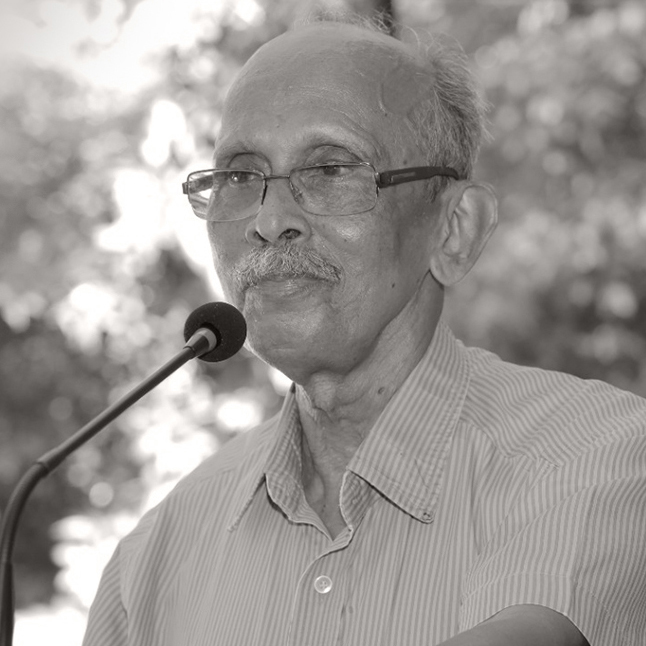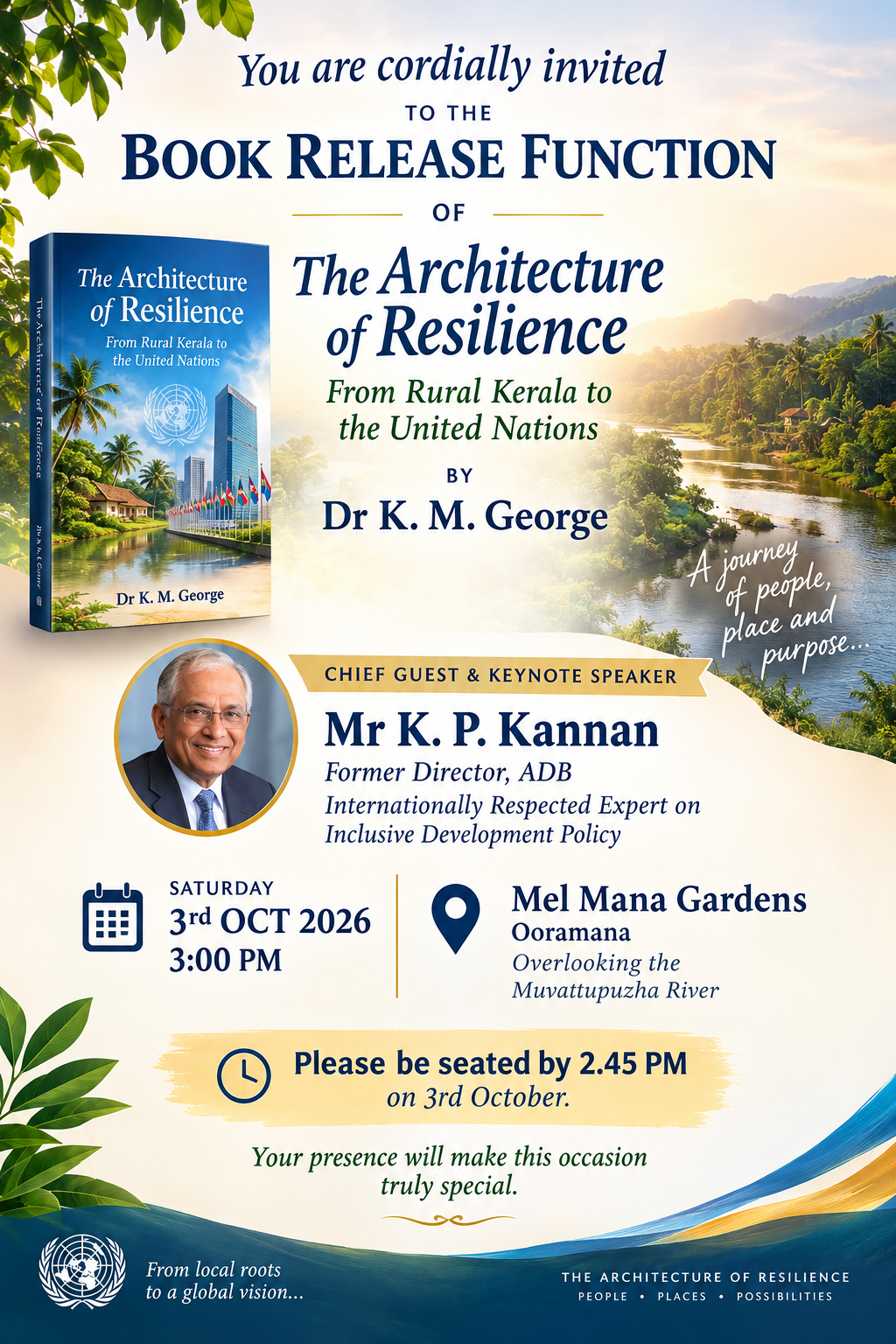
Experiences and Reminiscences of a lifetime, have been compiled into an invaluable narration by Dr. K M George. The Biography is being released by Mr. K P Kannan, former Director of Asian Development Bank, on Saturday the 3rd October 2026, at 3PM, at Melmana Gardens, Ooramana, Kerala, amidst the presence of various dignitaries and distinguished guests. You are cordially invited for the same.
THE MORAL ECONOMY OF GIVING – Philanthropy, Faith, Wealth and Power in a Fast-Changing 21st Century
Philanthropy is having something of a renaissance. At a time when governments are struggling to finance social protection, climate adaptation, public health and human development, private wealth is being invited — and increasingly volunteering — to fill part of the gap. New foundations are being established, family offices are professionalising their giving, corporations are expanding their social commitments and a new class of philanthropic advisers is helping wealthy families decide where, how and why to deploy their resources.
Yet philanthropy is not simply about generosity. It is also about power. This paper argues that the central issue is therefore not whether philanthropy is good or bad, but whether it is responsible, transparent, locally grounded and genuinely directed towards public purpose. Drawing on faith traditions, development economics and contemporary practice, it proposes ten policy directions for a philanthropic culture the paper terms “social stewardship” — one that strengthens human capability, public institutions and community resilience while remaining accountable to the society that ultimately gives wealth its meaning.
TAMIL NADU AT A TURNING POINT – A Personal Policy Memorandum for a New Era of Governance – From welfare to dignity, from expenditure to investment, and from political promises to measurable results
Hon’ble Tamilnadu Chief Minister,
You have inherited a State that has already achieved much.
That is precisely why the next stage will be difficult.
It is easier to build something where almost nothing exists. It is much harder to improve something that is already relatively successful.
Tamil Nadu is no longer simply trying to catch up. It is competing with the best-performing regions of India and, increasingly, with the best-performing regions of Asia.
That competition will not be won through rhetoric.
It will be won through institutions. It will be won through human capital. It will be won through infrastructure. It will be won through fiscal credibility. It will be won through investment. It will be won through productivity.
And, above all, it will be won through the confidence that ordinary citizens place in their government.
Your political movement has arrived at a moment when many people are willing to believe that a different style of governance is possible.
That is an enormous opportunity. But it is also an enormous responsibility.
The easiest thing would be to become another government.
The harder and far more historic task would be to become a different kind of government
Microfinance in India: Boon or Curse for the Poor and Voiceless?A Critical Review of Its Genesis, Misuses, and the Road to Revival
Microfinance was once celebrated as one of the most promising innovations in development finance: small, collateral-free credit to the poorest, leveraging social capital instead of physical assets. Originating in the successes of Grameen Bank in Bangladesh, microfinance was embraced in India through the SHG-bank linkage and later via private-sector MFIs. Over time, however, many microfinance programmes in India have faltered: high delinquency, over-indebtedness, lack of livelihood integration, and borrower distress have tarnished its reputation. This paper traces the genealogy of microfinance, contextualises its Indian adaptation, examines state-wise performance, analyses delinquency and PAR (Portfolio at Risk) data, and recounts cases of borrower distress and suicides. It diagnoses structural and regulatory failures and proposes a ten-point action plan to reframe microfinance as a tool of inclusive, sustainable development—particularly relevant for India’s ~1.46 billion population (2025 estimate). Policy prescriptions emphasise accountability, mutual guarantee, market linkages, data transparency, and borrower empowerment.
LONGEVITY IS NOT AN ACCIDENT – Wellness and the Art of Growing Older — A Charter for Senior and Super-Senior Citizens
There is a strange contradiction in the way modern societies look at ageing. We have learnt how to prolong life, but we have not always learnt how to make those additional years worth living.
A person may reach seventy, eighty, ninety or even a hundred, yet spend the final decades increasingly isolated, inactive and anxious, convinced that life has already passed them by. Another person may be eighty-five and still wake up every morning with something to do, somebody to meet, something to learn, somewhere to go, and a reason to look forward to tomorrow.
The difference is not merely the number on the birth certificate. It is wellness.
Longevity and wellness should be treated as two hands of the same clock. Longevity tells us how long we live; wellness asks how well we live. The real achievement is not adding years to life, but adding life to those years. The World Health Organization makes essentially this distinction in its concept of healthy ageing: the objective is to maintain functional ability and enable older people to do what they value — a capacity shaped not only by genetics but by physical and social environment, behaviour, community and opportunity.
This essay is addressed to senior citizens everywhere — in Kerala or California, Nairobi or New York, Tokyo or Toronto. Race, nationality, language and culture may differ; the human requirements for dignity, companionship, movement, nourishment, sleep, meaning and hope are remarkably universal. The message is simple: do not retire from life merely because you have retired from employment.
Bridging the AI Technology Gap Before It Becomes a Chasm
The world is living through a paradox. Never before have we witnessed such extraordinary leaps in technology, particularly in artificial intelligence (AI). Yet never before has the risk of exclusion been so stark. While AI transforms health, education, commerce and governance in advanced economies, large parts of the globe remain on the margins — struggling with basic digital infrastructure, skills shortages, and limited say in shaping the rules of the game.
This is not just a “digital divide” anymore. It is an AI divide, growing faster than many policymakers realize. Left unchecked, it will deepen inequality between nations and within societies. The United Nations’ recent Governing AI for Humanity report makes it clear: without urgent, coordinated action, the very technology that could help us solve global challenges may instead amplify them.
From Rome to the Field: Ground-Level Interventions for Agricultural Heritage, Food Security and Farmer Dignity
As FAO celebrates its 80th anniversary and honours a new cohort of 28 heritage agricultural systems across 14 countries—bringing the total globally recognised agricultural heritage sites to 102 in 29 countries — there is both a moment of celebration and a moment of responsibility. These heritage systems remind us that small-scale farmers, drawing on centuries of labour, knowledge and place-based adaptation, are at the heart of food security, biodiversity, rural resilience and cultural identity.
The Silent Poison on Our Plates: Why Microplastics Demand a Global Reckoning
There is a peculiar cruelty in the way modern civilisation is poisoning itself: silently, invisibly, through the ordinary act of eating a meal. Microplastics — fragments under five millimetres across, shed from packaging, synthetic clothing, tyres and cosmetics as they weather under sun and wave — have travelled from ocean sediment into rice, salt, fish, drinking water and now, unmistakably, into us. A landmark 2024 University of New Mexico study found microplastic contamination in every one of 62 human placentas it examined, at concentrations ranging up to 790 micrograms per gram of tissue. Blood studies have detected plastic particles in roughly three-quarters of healthy adults tested. Earlier this month, researchers reported microplastics in nearly every human brain sample they analysed, including from people who had shown no sign of illness. What began three decades ago as an eyesore on beaches has become a public-health question that most governments still have not found the nerve to ask.
Women’s Empowerment and Marine Algae: Global Perspectives With Special Reference to India, Brazil, South-East Asia, Latin America, Europe, and Japan
Marine algae—popularly recognised as seaweeds—constitute one of the planet’s oldest, most productive, and most climate-resilient biological resources. Sustaining diverse ecological and economic functions, seaweeds contribute significantly to nutrition, blue carbon sequestration, climate mitigation, circular bio economies, and coastal livelihoods. Globally, between 8–10 million women depend directly or indirectly on seaweed-related activities.
GLOBAL ETHICAL FRAMEWORK FOR ARTIFICIAL INTELLIGENCE AND FAITH
This policy paper examines the profound ethical, moral, spiritual, and societal challenges posed by Artificial Intelligence in relation to faith, religion, human values, law, and social order. It argues that while AI offers transformative benefits, its unchecked deployment risks eroding human dignity, moral responsibility, family life, justice systems, and spiritual discernment. Drawing upon shared wisdom from global faith traditions and ethical thought, the paper proposes a Global Ethical Framework for AI and Faith. It presents guiding principles and policy recommendations aimed at ensuring that AI remains human-centred, value-driven, and accountable, contributing to a just, compassionate, and sustainable world order.