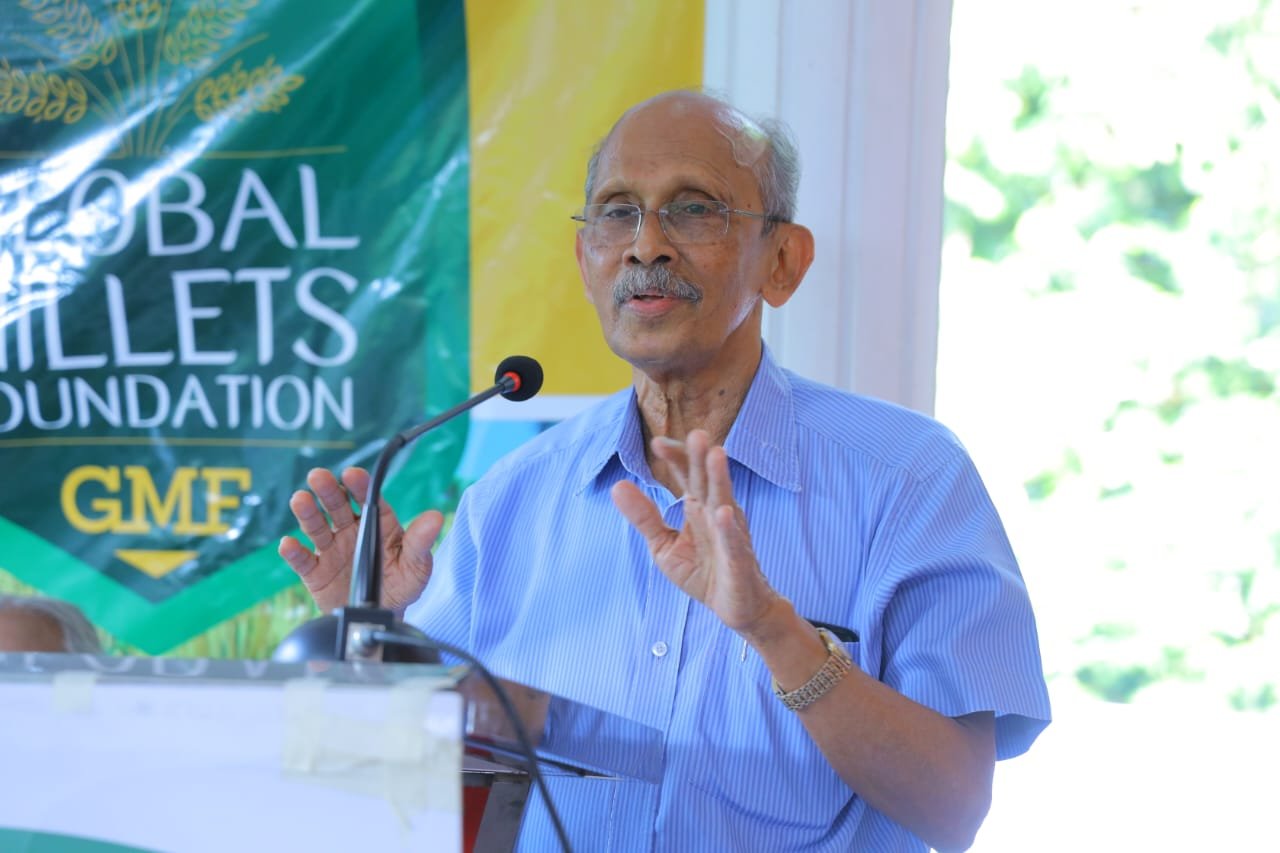
Millets — a botanically diverse group of small-seeded, drought-hardy grasses that include sorghum, pearl millet, finger millet, foxtail millet, proso millet, barnyard millet and kodo millet — are re-emerging as strategic crops for sustainable agriculture, environmental resilience and public health. This paper draws together the agronomic, nutritional and clinical evidence on millets, with particular attention to their therapeutic relevance for lifestyle diseases such as type 2 diabetes, cardiovascular disease, hypertension, obesity and coeliac disease. The evidence shows that millets combine a low glycaemic index, high dietary fibre, favourable lipid-modulating and anti-inflammatory phytochemistry, and an exceptional tolerance of drought and heat that requires far less water than rice or wheat. Together these properties make millets a practical, low-cost intervention for both climate adaptation and non-communicable disease prevention, particularly across the arid and semi-arid tropics of Asia and Africa. The paper closes with ten policy recommendations addressed to national governments, public-health authorities and the international wellness community, aimed at mainstreaming millets within food-security and preventive-health strategy.
Nepal Cannot Afford to Rebuild the Same Country After Every Disaster
Nepal’s earthquakes, monsoon floods, landslides and glacial-lake hazards are not occasional shocks; they are structural features of a young mountain landscape now under mounting pressure from a changing climate and unplanned development. The country’s disaster losses since the 1930s – most severely in the 2015 Gorkha earthquake, which killed nearly 8,700 people and destroyed close to half a million homes – show that Nepal keeps rebuilding the same vulnerabilities it lost the last time. This paper argues for a shift from a relief-and-reconstruction model to a permanent national resilience model, built on ten interlocking pillars: hazard mapping, risk-sensitive land use, landslide prevention, watershed restoration, river management, glacier and glacial-lake monitoring, earthquake-safe construction, biodiversity protection, community preparedness and long-term resilience financing. The recommendations are addressed both to the Government of Nepal and to the international development community.
From Rome to the Field: Ground-Level Interventions for Agricultural Heritage, Food Security and Farmer Dignity
As FAO celebrates its 80th anniversary and honours a new cohort of 28 heritage agricultural systems across 14 countries—bringing the total globally recognised agricultural heritage sites to 102 in 29 countries — there is both a moment of celebration and a moment of responsibility. These heritage systems remind us that small-scale farmers, drawing on centuries of labour, knowledge and place-based adaptation, are at the heart of food security, biodiversity, rural resilience and cultural identity.
Yet too often, programmes remain in conference rooms in Rome or capital cities, while the farmer who tills the land—who faces erratic weather, climate shocks, market instability and policy neglect—sees little return, little dignity and little resilience. The recent cyclone damage to standing crops in Andhra Pradesh and elsewhere provides a clear warning that we must move from recognition to grass-roots interventions that enable small farmers to realise value and resilience.
This policy paper calls on agriculture ministers and FAO to adopt ten concrete recommendations that will reshape the narrative: from heritage as an academic or tourist badge to heritage as a living, remunerative, dignified pathway for farmers and their landscapes.
A Potential Panacea for Snakebites: Hope, Realities and the Road Ahead
Each year, across the tropical and subtropical world, thousands of lives are lost or irrevocably damaged by snakebite envenoming. The latest scientific developments—especially a promising “broad‐spectrum” antivenom—have generated hope. But what exactly does this breakthrough mean for rural masses, for farmers, for productivity and development in Asia and Africa? And when, if ever, might it become a transformative relief? Below is a synthesis of the current knowledge, the realistic challenges and the implications for rural livelihoods and global health.
Venezuela, Heavy Crude, and the Limits of Monetary Hegemony: Oil Quality, the Petrodollar, and the Emerging Geopolitical Order
Venezuela’s prolonged economic and political crisis is often explained through a narrow lens of domestic mismanagement and authoritarian governance. While these factors are significant, they represent only a partial account. This article advances a dual-structure argument: first, that Venezuela’s oil wealth is technically constrained by the heavy, high-sulphur nature of its crude and the institutional degradation of PDVSA; and second, that Venezuela’s attempt to transact oil outside the US dollar system positioned it as a strategic challenger to the petrodollar regime. The article evaluates competing explanations, situates Venezuela within broader de-dollarization dynamics, and outlines policy implications for an emerging multipolar monetary and energy order
When Moral Authority Must Yield to Constitutional Necessity: An Open Appeal to Professor Muhammad Yunus**
Bangladesh stands today at a historic crossroads. Nations are not destroyed only by dictatorships; they are equally imperilled by prolonged uncertainty, institutional ambiguity, and the conflation of moral authority with executive power. Professor Muhammad Yunus, a globally admired Nobel Laureate and pioneer of microfinance, commands immense respect for his contributions to poverty alleviation, women’s empowerment, and social entrepreneurship. His legacy through Grameen Bank and related institutions is secure and globally celebrated.
Women’s Empowerment and Marine Algae: Global Perspectives With Special Reference to India, Brazil, South-East Asia, Latin America, Europe, and Japan
Marine algae—popularly recognised as seaweeds—constitute one of the planet’s oldest, most productive, and most climate-resilient biological resources. Sustaining diverse ecological and economic functions, seaweeds contribute significantly to nutrition, blue carbon sequestration, climate mitigation, circular bio economies, and coastal livelihoods. Globally, between 8–10 million women depend directly or indirectly on seaweed-related activities.
AI for Dignity: Revitalising Indian Agriculture from Distress to Resilience – A Policy Paper for the Global Summit on Artificial Intelligence, New Delhi – February 2026
Indian agriculture employs nearly half of the nation’s workforce yet remains trapped in a vicious cycle of low incomes, high drudgery, climate volatility, gender invisibility, occupational hazards, weak market power, chronic indebtedness, and alarming levels of psychological distress culminating in farmer suicides. This paradox—where those who feed the nation remain among its most vulnerable—represents one of the gravest policy failures of post-independence India. This paper argues that Artificial Intelligence (AI), if ethically governed and inclusively deployed, can become a transformative public good capable of restoring dignity, resilience, and remunerative value to Indian agriculture.
GLOBAL ETHICAL FRAMEWORK FOR ARTIFICIAL INTELLIGENCE AND FAITH
This policy paper examines the profound ethical, moral, spiritual, and societal challenges posed by Artificial Intelligence in relation to faith, religion, human values, law, and social order. It argues that while AI offers transformative benefits, its unchecked deployment risks eroding human dignity, moral responsibility, family life, justice systems, and spiritual discernment. Drawing upon shared wisdom from global faith traditions and ethical thought, the paper proposes a Global Ethical Framework for AI and Faith. It presents guiding principles and policy recommendations aimed at ensuring that AI remains human-centred, value-driven, and accountable, contributing to a just, compassionate, and sustainable world order.
Crop Waste, Air Pollution, and Sustainable Transitions in Indian Agriculture: A Policy Paper
Crop waste management has emerged as one of the most consequential yet persistently neglected challenges in Indian agriculture and global sustainability governance. India generates over half a billion tonnes of agricultural residues annually, a substantial portion of which continues to be disposed of through open-field burning—most visibly in the rice–wheat systems of Punjab, Haryana, western Uttar Pradesh, Rajasthan, and Madhya Pradesh. The resulting air pollution regularly engulfs Delhi and large parts of northern India, producing severe public health impacts, economic losses, ecological stress, and reputational costs for the country.